
Kamore Maureen
DATA ANALYST
SQL| PYTHON| EXCEL| POWER BI
ABOUT ME
As a data analyst with a background in Actuarial Science, and hands-on experience in data analysis, I am committed to delivering high-quality analyses that support strategic decision-making. My proficiency in SQL, Python,Excel and Power BI. I excel in uncovering trends, optimizing processes, and presenting data-driven recommendations to stakeholders. Committed to continuous learning and collaboration, I approach each project with a positive growth mindset.
Cable Prime analysis
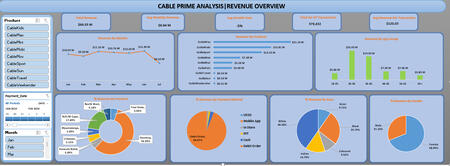
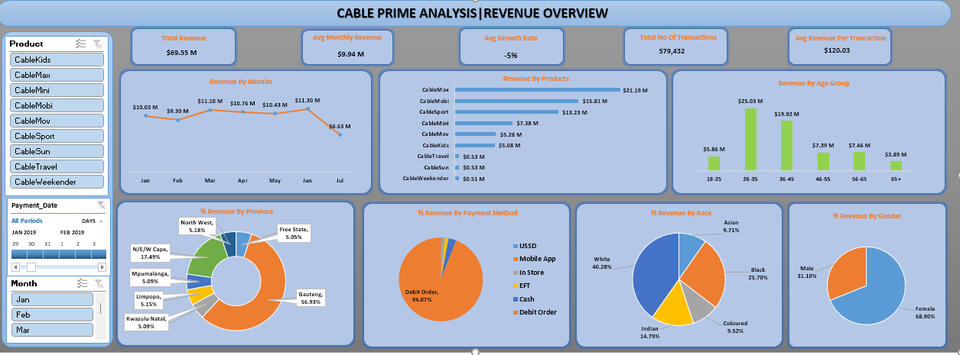
The Cable Prime Excel Project involves analyzing sales and customer data for Cable Prime to provide actionable insights. Using Excel dashboards, key performance indicators (KPIs) such as total revenue, growth rate, customer demographics, and product sales were examined.
Adidas Sales Analysis
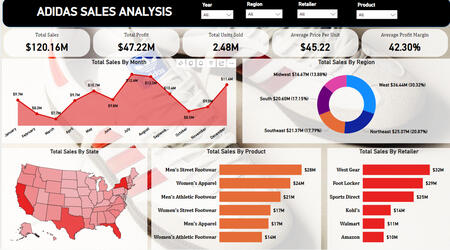
Using Power BI, I analyzed $120M+ in total sales across various regions, products, and retailers to uncover key insights.
The dashboard highlights sales seasonality, top-performing products, and region-specific performance, providing actionable recommendations for growth.

BlinkIT Sales Analysis
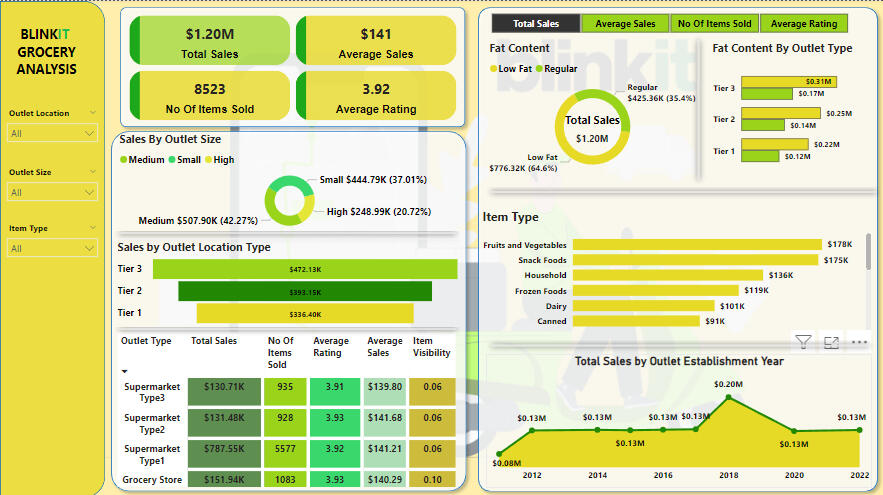
Using PowerBI, the dashboard presents a comprehensive analysis of Blinkit Grocery Sales performance, segmented by various factors like outlet size, location type, outlet establishment year.
Click on the picture to view project details
Adidas Sales Analysis
Introduction
In this project, the aim is to empower Adidas’s decision makers with data driven insights fostering strategic growth and competitiveness in dynamic sports and athletic industry.Business Requirement
Adidas Sales Analysis project is driven by questions that need to be answered.
• The goal is to enhance understanding of sales dynamics and performance drivers.
• Identify geographical areas with high and low sales.
• Insights into product performance, aiding in inventory and marketing decisions.
• Informed Pricing and margin strategies for improved profitability.
• Actionable recommendation for optimizing sales and profit across various dimensions.Data Cleaning, processing and analysis
• Added a calculated total sales column, this column helps us to understanding total revenue generated throughout the years. Analysing overall sales performance over time.
• Added a calculated % operating margins column, this column helps us evaluate % profit generated by Adidas across different dimensions
• Changed the Invoice date to the correct date format.
• Checked the dataset for duplicates to ensure high data quality.Insights
1. Top-Performing Region
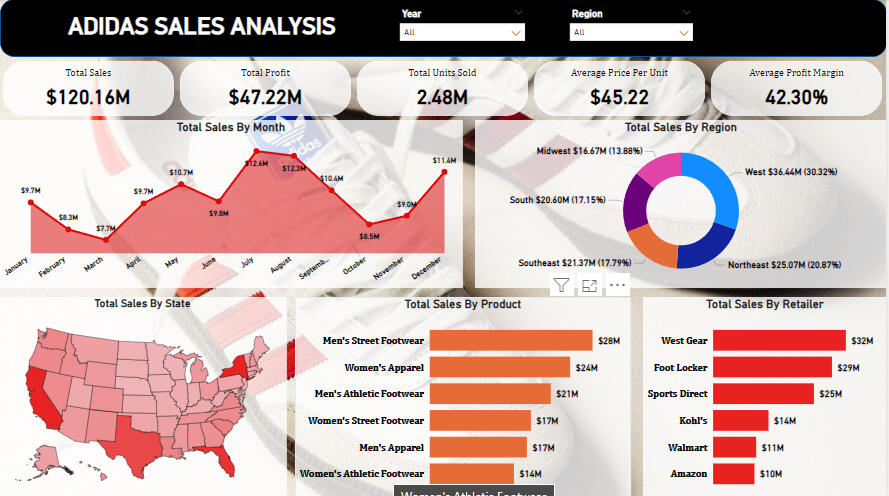
• West Region is the top-performing region, contributing 30.32% of total sales, amounting to $36.64M. This indicates a strong market presence in the western United States, and efforts in marketing or distribution here are yielding excellent results.
2. Sales Seasonality
• There is a clear seasonal trend in sales, with July ($12.4M) and August ($12.3M) being the top-performing months. This could be due to potential promotions or new product releases in July and August. During the December holiday sales do up to ($11.4M). On the contrary, the beginning of the year (January-March) shows lower sales, implying possible slow seasons.
3. High Sales Concentration in Specific Product Categories
• Men’s Street Footwear ($28M) is the best-selling product, followed by Women’s Apparel ($24M) and Men’s Athletic Footwear (21M). Footwear, in general, dominates sales, indicating its importance in Adidas' product lineup.
• This suggests that Adidas' core market is heavily reliant on footwear products, and further innovation or marketing in this category could continue driving growth.
4. Retailer Performance
• West Gear Retailer leads sales among retailers, generating ($32M), followed by Foot Locker ($29M) and Sports Direct ($25M). Adidas seems to have strong partnerships with these retailers, and they are responsible for a significant share of sales.
• There is a sharp drop-off in sales for Walmart and Amazon, with $11M and $10M respectively, which suggests that traditional brick-and-mortar or sports-specific retailers are more successful sales channels compared to online or general retail platforms.
5. Profitability
• The Average Profit Margin is 42.30%, which is relatively high for the retail sector. This indicates that Adidas is maintaining healthy profit margins across its product lines, which could be attributed to premium pricing or efficient cost control.
• However, analyzing margin trends across different product lines or regions could reveal further opportunities for optimization.
6. Geographic Sales Distribution
• West and Northeast regions combined account for over 50% of total sales (West: 30.32%, Northeast: 20.87%). These regions should remain a priority for marketing and distribution strategies, while the Midwest ($16.67M, 13.88%) could potentially offer untapped growth opportunities if further efforts are directed towards improving sales in that region.
7. Sales by Product Type Reflects Strong Gendered Demand
• Men’s footwear (both street and athletic) significantly outsells women’s footwear ($28M + $21M vs. $17M + $14M). This suggests that Adidas may have a stronger customer base among men, particularly in the footwear category. Expanding women's street footwear and Athletic footwear lines could provide opportunities for growth.Recommendations
1. Expand in the West and Northeast Regions: Given the high sales in these regions, increasing advertising and product availability here could sustain the growth.
2. Capitalize on Seasonality: To maximize on seasonal trends, Adidas could launch targeted promotions or new product lines around July and August as well as the holiday season in December. While also devising strategies to mitigate the slow periods (e.g., January–March).
3. Focus on Brick-and-Mortar Retailers: West Gear, Foot Locker, and Sports Direct are strong sales channels. Strengthening partnerships with these retailers, possibly through exclusive product lines or collaborations, could further boost sales. However, Adidas might also explore ways to improve its online presence, especially with Amazon.
4. Product Focus: While footwear dominates, women's categories, especially in footwear, have room for growth. Marketing campaigns targeting women and expanding the product variety for Women's Footwear could close the gap.
Click on the picture to view project details
BlinkIT Sales Analysis
BlinkIt Grocery Dataset we need to conduct a comprehensive analysis of sales performance, customer satisfactions, inventory distribution to identify Key insights using KPIs and Power BI dashboard.Projects Steps:
• Figure Out the Business Requirements.
• Data Walkthrough.
• Data Connection.
• Data Cleaning.
• Data Modelling.
• Data Processing.
• DAX Calculation.
• Dashboard Layout.
• Charts Development and Formatting.
• Report Development.
• Insights Generations.Business Requirements: Understand the sales performance, customer satisfaction and inventory distribution.
KPIs Requirements: Total Sales, Average Sales, Number of Items, Average Ratings.Charts Requirements
• Total Sales by Fat Content.
• Total Sales by Item Type.
• Fat Content by Outlet for Total Sales.
• Total Sales by Outlet Establishments.
• Total Sales by Outlet Size.
• Total Sales by Outlet Location
• All metrics by Outlet TypeOverview of Key Metrics
• Total Revenue Generated $1.20M indicates overall sales for this analysis period.
o Increasing the variety and availability of top selling categories could continue driving sales upward.
• Average Revenue Per Sale $141 represent the typical spending per customer visit, which is essential to understanding the purchasing power and behavior of shoppers.
o Focusing on items that are both high in demand and profit margin could increase the value of each transaction.
• Number of Items Sold 8523 highlights overall volume and demand trends for the company’s products.
o To improve the number of items sold, stores should focus on restocking top-selling categories
• Average Customer Rating for Items Sold 3.92 indicates a solid customer satisfaction, but there is room for improvement.
o To further improve ratings, customer feedback mechanisms should be implemented, and areas like store cleanliness, customer service, and availability of popular products should be optimized.
o Investing in training for staff and infrastructure could help raise satisfaction levels.Total Sales by Fat Content
• Low-fat products dominate the sales with 64.6%, as well as taking a lead in all the outlet type, reflecting changing consumer preferences for healthier eating.
• Regular fat products still maintain a substantial share, but health trends seem to be driving the majority of purchases.Insights: Given the strong consumer shift towards low-fat products, outlets should consider increasing their offerings in this category. Marketing strategies can further push this trend by highlighting the health benefits of low-fat products.Total Sales by Item Type: Top Performing Item Types
• Fruits and Vegetables ($178K) lead sales by item type, indicating customers prioritize fresh produce.
• Snack Foods ($175K) come second, reflecting the demand for convenient, quick-to-consume products.
• Frozen Foods ($136K) and Household Items ($101K) also contribute significantly, showing demand for easily storable and essential everyday products.Insights: Expanding the variety of fresh produce and snacks in stock could drive further growth. Regular promotions and marketing strategies around these high-demand items (e.g., bundle offers or discounts) could encourage customers to purchase more.Total Sales Establishment Year
• The outlets established in 2018 have the highest sales at $0.20M, suggesting that they might have launched a new product or had a promotion going on.
• Outlets established in 2012, 2014, and 2016 have consistent but lower sales. This may be due to market saturation or declining relevance.
• Newly established outlets (2020 and 2022) show promising sales but need more time to mature.
Insights
• Mature outlets (like those from 2018) should be examined for best practices in operations and customer engagement, and these practices should be applied to newer outlets.
• Meanwhile, newly established outlets could benefit from more aggressive marketing to catch up to their established counterparts.
• Also find out what outlets established in 2018 did different to have such sales.Total Sales by Outlet Size
• Medium-sized outlets are leading with 42.27% of sales. Small outlets follow closely with 37.01%, while high outlets contribute 20.72%.
• This suggests medium outlets are more optimally structured for customer traffic and product offerings, driving more sales.Total Sales by Outlet Location Type
• Tier 3 areas dominate with $472.13K in sales, possibly due to higher demand in less urbanized areas. This could be due to lower competition or higher customer reliance on a fewer grocery outlet.
Insights
• Medium-sized outlets in less populated (Tier 3) areas should be prioritized for expansion or resource allocation, as they perform best. Additionally, increasing the variety and availability of low-fat and fresh produce items could continue driving sales upward.Recommendation
• Focus on expanding the medium-sized stores in Tier 3 locations because they have the most potential for growth and optimization.
• Expand product lines for low-fat and fresh produce items, maintaining high item visibility.
• Invest in marketing low fat products aggressively.
• To boost customer satisfaction, further improvements in service, product availability, and store experience should be considered.
• We need to explore why the sales peaked in 2018 established outlets and strategies to replicate that success.
Cable Prime Analysis
Data Cleaning and Pre-processing
• Convert Payment Amount: Remove the dollar sign, edit outlier and convert it to a numeric type. Removed the spaces in payment column between 1 and 0 using find and replace.
• Convert Payment Date: Convert the integer date into a proper readable date format through Text to Columns data tool.
• Removed data from the Month of August because it is incomplete, I am working with a monthly data. This could affect my results.
• Handle Missing Data: Customer Identifier column edited the negative value as well as a one blank space.
• Replaced NULL with NOT SPECIFIED in the Payment Method and Gender columns.
• Replaced #N/A with NOT SPECIFIED in the Race and Province columns.
• Replaced one #N/A in Product ID column with another Product ID. (32384)
• Added new columns that is Product Name and Product Description into the Payment sheet.
• Deleted Outlier Detection in Age Column, below 18 of age and age 200 and 188.
• Added Age group column, setting appropriate age ranges using IF statement.
• Check for Duplicates: Ensure no duplicate rows exist in the dataset.
• Ended up with a dataset of 579433 rows and 12 columns.Business Requirement
What products drive the most sales?
What percentage of sales currently comes from each region? Is there a target region for expansion?
Which regions are underperforming and need more attention?
How can we adjust our marketing strategy to different customer segments to increase sales?
Which payment methods are most popular, and how do they impact customer purchasing decisions? and can we optimize our payment process?Revenue and Customers Overview By Month
• Revenue and customer numbers peaked in March at $11.10M and 80,084 respectively but since then, there has been a consistent decline.
• Revenue and customer numbers also peaked June at $11.30M and 84,188 respectively, this indicates potential seasonality in sales and demand in certain months in Q1 and Q2.
• We can assume the sales and customer numbers hiked in March as it was a school holiday and June because it was a football season.
Revenue and Customer Overview By Product
• CableMax leads in terms of Revenue and Customer count. There seems to be a correlation between the products that generate the most revenue and those with the highest customer count, indicating consistency in customer preferences.
• CableMax is preferred by most customer because it is an all-inclusive connection on all devices, all shows 24/7.
• Assumption made that CableMax meets customer needs the most. This leads to higher revenue and customer count.
Revenue and Customers Overview By Age
• The largest age group is 26-35 years, with high revenue and customer count closely followed by age group 36-45 years.
• These groups drive the most sales, while the younger and older age groups contribute less, likely because the most of the products cater more to middle-aged customers.
Revenue and Customers Overview By Province
• Gauteng contributes a significant portion of the revenue as well as the customer count suggesting the region is the primary market.
• This points to potential opportunities for growth in underrepresented regions.
• Assumption made is that there is more product awareness in Gauteng compared to other regions. Also possibly due to a higher population density.
Customer By Payment Method
• Debit Order dominates as the payment method, indicating that most customers prefer automatic recurring payments. This indicates stable and recurring customer base but also highlights the need to diversify and expand digital payment options.Customer By Race
• Racial breakdown shows a fairly diverse customer base, with White customers making up 40.86%.Customer By Payment Method, Race and Gender
• The breakdown shows that females take the lead compared to male, indicating that women are the primary customers. This could be related to the types of products offered, or how the products are marketed.Recommendations
Expand Product Offering
• Introduce new products to capture a larger audience, particularly targeting the 18-25 age group customers who are currently underrepresented. Offering more affordable options for lower-income customers could also drive higher sales volume.
Increase Customer Retention
• Set up loyalty programs and promotions to increase customer retention and encourage repeat purchases.
• Engage existing customers more actively through personalized offers and promotions based on purchase history.
Geographic Expansion
• Focus aggressive marketing on underperforming provinces like Limpopo, Free State, Kwazulu Natal and Mpumalanga to grow the customer base.
• Offer region-specific promotions and localized marketing to attract new customers.
Seasonal Promotions
• Develop targeted seasonal promotions to mitigate the sharp decline in sales after the peak season. Special campaigns during off-peak months can help smooth out the revenue curve.
Leverage Digital Channels
• Increase the use of digital marketing to capture a younger audience. This could involve more online advertising, social media engagement, and expanding the mobile app as a primary channel for sales.
Improve Sales and Marketing Strategies
• Invest in more aggressive marketing campaigns to increase brand awareness. Partner with influencers or run media campaigns targeting under-penetrated demographics (younger customers and males).
Bundle Products and Upsell
• Create bundled product offers that encourage customers to purchase multiple products at once. Upsell to high-value customers by offering premium services or special bundles with discounts.
Improve Customer Experience
• Focus on improving the customer experience both online and offline, ensuring that customers feel valued. This can drive higher satisfaction and repeat business.